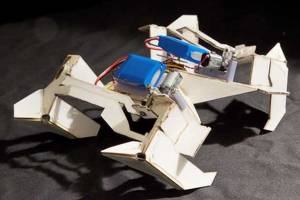
 Robots that arrive flat, fold themselves into three dimensions, then walk away–it sounds like the future, but this future is already here in the engineering labs at Harvard University’s Wyss Institute for Biologically Inspired Engineering. The robots are based on folding techniques practiced for centuries by origami artists who create paper sculptures from single pieces of paper. For this robot project, supervised by Sam Felton, a doctoral candidate at Harvard University’s School of Engineering and Applied Sciences, the paper has been lined with Shrinky Dink, a children’s toy plastic that shrinks when heated. Tiny circuits in the flat robot heat and bend the paper into position without the help of human hands. Batteries and a small motor enable the robot to walk, and although these are not currently flat components, eventually two-dimensional versions will be available. Jesse Silverberg, a graduate student in physics at Cornell, says, “Imagine this: A building collapses, and you have a snakelike robot that can go into debris. And as it unfolds, it goes from a soft robot to a rigid barrier that could protect people. It folds one way to crawl into tight spaces and another way to become a protective barrier. It can transform its function on the fly.” To see this robot in action, visit the Bloomberg News article on the subject.


 The Popular Edge, Pop-Up and Book Arts News